AI for Small Business in Sydney: A Practical 2026 Guide
Sudipta Nath · 7 min read ·
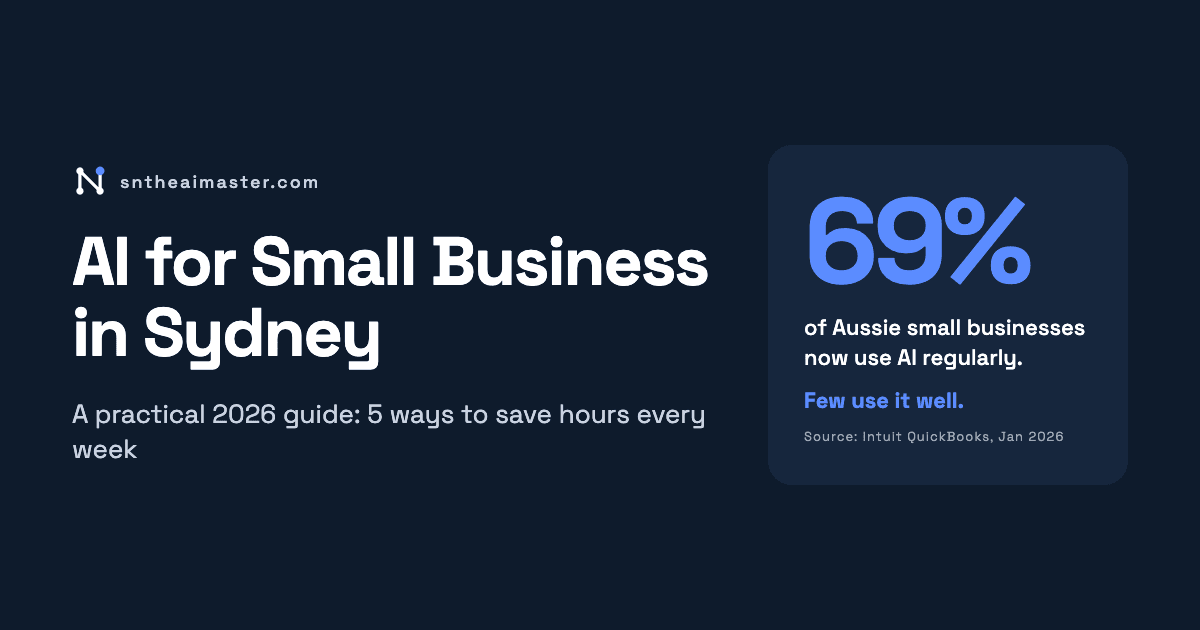
Here's something that surprised me. Australian small businesses aren't avoiding AI any more. Intuit QuickBooks surveyed Australian small and mid-sized businesses and found regular AI use jumped from 40% in July 2024 to 69% in January 2026. Over the same time, daily use went from 9% to 28%.
So the question is no longer “should I use AI?”
The question is: why are so many business owners using AI and still feeling just as busy?
I see this from two sides. I've built AI systems as an AI engineer at an identity-verification startup, and I've also worked hands-on in Sydney hospitality, where every minute in a shift counts. Here's what I've learned about where AI actually saves time for small businesses, and where it's just hype.
The real problem: using AI is not the same as being AI-enabled
Ask ten business owners if they use AI and most will say yes. Ask them how, and you'll usually hear: “I use ChatGPT to write emails sometimes.”
That's a start, but it's not where the value is. Deloitte Access Economics found that just 5% of the surveyed SMBs already using AI were fully enabled. Its modelling estimated a $44 billion annual GDP opportunity if one in ten businesses in the basic and intermediate groups moved up one level of AI maturity.
Different surveys give different adoption numbers: the National AI Centre reported 43% of SMEs across December 2025 to February 2026, and NAB reported 42%. The samples, periods and definitions differ, so those figures aren't directly interchangeable. But they point to a useful distinction: trying AI and building it into day-to-day work are different things.
That gap is your opportunity.
5 practical ways to use AI in your small business
1. An AI assistant on your website that answers customers 24/7
How many times a week does someone ask “What are your hours?”, “Do you do gluten-free?” or “How much for a consultation?”
A well-built AI chatbot grounded in your business information can answer routine questions at 11pm, on a Sunday, and in multiple languages. For a multicultural city like Sydney, helping a customer in their own language can make the experience more useful.
Tip: a good chatbot should also capture the lead—with the customer's consent—and send you their name, contact details and what they need. It should know when to hand over to a person.
Explore custom AI assistants and agents.
2. Online ordering and bookings that run themselves
If customers still have to call you to order, book or reschedule, you can miss enquiries during your busiest hours, exactly when you can't pick up the phone.
Smart ordering and booking systems can take orders, send reminders, suggest add-ons, and reward repeat customers automatically. I've built this kind of system for a local café, and the biggest win wasn't the tech. It was the owner getting their phone time back.
You can explore the ordering, rewards and admin platform in my Stix Eatery case study, or browse my other projects.
3. Turn one hour of content into a week of social posts
Marketing is usually the first thing to slip when you're busy. AI can take one idea, a photo, or a short video and help turn it into captions, a blog post, an email and a week of social posts in your brand voice.
You still approve everything. AI just removes the blank-page problem.
4. Cut the admin: invoices, emails and paperwork
Payroll, quotes, reading supplier emails, chasing invoices: these are the tasks that can take up a large part of the week. The Tech Council of Australia's October 2026 research estimated that an average SME moving from no AI use to broad adoption could achieve annual productivity gains worth around $136,000. That's a modelled estimate, not a promised saving for an individual business.
You don't need to automate everything on day one. Pick the one task you hate most every week and start there.
5. Use your own data to make better decisions
Your sales system may already hold clues about which products sell on rainy Tuesdays, which customers haven't come back in a month, and which staff roster works best. With suitable data and checks, AI can help turn that information into plain-English questions and suggestions.
For example: “Should we order more stock for Friday?” or “Which customers haven't visited in 30 days?” Check the evidence before changing stock, staffing or customer communications.
“But is it safe?” — the honest answer
This is a common worry, and it's a fair one. Privacy and security concerns were raised by 39% of Australian respondents in Intuit's research, more than in the US, UK or Canada.
Here's my simple rule: never paste customer personal information into an unapproved public AI tool. A properly built AI system for your business should:
- Keep your data in a secure, controlled environment.
- Only access what it needs.
- Let a human review anything important before it goes out.
Having worked on AI for identity verification and document fraud detection, I take this part seriously. Those safeguards should be designed in from the start.
Where should you start?
You don't need a big budget or an IT team. Start with three questions:
- What question do customers ask me most often? That's a possible starting point for your chatbot.
- What task eats the most hours every week? That's a candidate for your first automation.
- Where am I losing customers? Missed calls, slow replies or no online ordering can help identify what to improve first.
Solve one of those properly, then measure the difference over the first month.
FAQ
How much does AI cost for a small business?
Many tools start free or at a low monthly fee. A custom AI website or chatbot costs more upfront but is built around your business. Whether it pays for itself depends on the time saved, leads captured, and build and running costs.
Do I need technical skills to use AI?
No. A good AI setup should feel like using any normal app. The technical work happens behind the scenes.
Will AI replace my staff?
AI can take over repetitive tasks so your team can focus on customers. The effect depends on how it is introduced. Intuit's Australian research found more surveyed businesses linked AI to increased hiring than to job losses.
What's the easiest AI tool to start with?
A website chatbot or an AI writing assistant for marketing can be a practical starting point. Choose a specific task, check the output and measure whether it helps.
Want AI working in your business, not just talked about?
I build AI-powered websites, chatbots and custom AI tools for Sydney small businesses: practical systems designed around how you actually work.
Book a free 20-minute chat and tell me the one task you'd love to never do again. We can work through whether AI could help.
Your turn: which task in your business would you hand to AI first? Tell me by email. I read every message.
Sources
- Intuit QuickBooks — AI Impact Report Australia 2026
- Deloitte Access Economics — The AI edge for small business
- National AI Centre — AI adoption insights, December 2025 to February 2026
- NAB — Embracing AI: Adoption & Key Opportunities for SMEs, April 2026
- Tech Council of Australia — TCA AI x SME research launch
- eCommerceNews — Australian small businesses see AI boost jobs & revenue
- IBS Intelligence — AI adoption surges among Australian SMEs
- eCommerceNews — Australian SMEs adopt AI but lag on workflow change
- IT Brief — AI adoption could add AUD $93 billion
Have a question about this work?
Let’s talk.